>>> FRENCH VERSION OF THE ARTICLE HERE
To Rosalía Vila Tobella
Hello to you who are taking the time to pause on this article. Before getting to the heart of the article, I would like to thank you for the attention you give to this piece of writing, created in my spare time, driven by the energy and passion that move through me whenever art and music are involved.
The various videos, images, and other media used in this article come from a range of sources. Whenever possible, I have made sure to credit their authors or origins. Content without specific attribution consists of images and videos that I captured myself during the concert.
This article is dense, I am aware of that, but it is so in proportion to the experience lived during Rosalía’s show, which carried that same breadth and intensity. Thank you for your reading, and thank you for considering sharing it if you feel inclined to do so, and if this immersion has moved you.
Enjoy your reading.
MARCH 18, BOULEVARD DE LA VILLETTE, PARIS, IN MY APARTMENT, 8:35 A.M.
During the night from Tuesday to Wednesday, March 17–18, I dreamed of Rosalía.
Yes, I dreamed of Rosalía, which is already, in itself, let’s admit it, an interesting phenomenon.
Not so much because dreaming of a public figure would be rare (on the contrary, it is a fairly banal cliché of contemporary dream life), but because the way she appeared in this dream escaped precisely that status of “public figure.” She was not Rosalía-as-icon, nor Rosalía-as-mediated-image, but rather a relational presence, almost intimate, which (and this is where the phenomenon becomes slightly unsettling) implies that my brain had decided, in a completely arbitrary way, to assign her a place within my internal affective economy.
In this dream, we were hanging out together. A simple phrasing, almost poor, but difficult to replace without overloading it unnecessarily. “Hanging out” implies an absence of clear purpose, a suspension of stakes, a form of mutual availability which, in real life, is already rare, but which, in a dream, becomes almost the norm.
As for the setting, it resisted any attempt at descriptive stabilization. I think it was some kind of youth center (a Maison des jeunes et de la culture), a mental youth center, hybrid, slightly unstable, as if its very architecture hesitated between several possible states. It was not a precise place, but rather an aggregation of familiar locations, recomposed according to a logic that obeys neither geography nor faithful memory, but a kind of internal necessity proper to the dream.
In this dream, there was a large main room. And in that room, something seemed to be preparing itself. I say “seemed” because nothing was explicitly underway, yet everything suggested that a latent event was about to occur, a performance, perhaps, or more precisely the idea of a performance, which is something else entirely, a kind of promise without defined content.
Then this is where the dream reveals its particular logic, at once arbitrary and perfectly acceptable in the moment, for, without transition, without perceptible movement, without even what cinema would call a “cut,” we found ourselves outside, in a parking lot.
No door crossed.
No path taken.
Simply an ellipsis.
But an ellipsis which, rather than producing a rupture, instead established a strange continuity, as if the passage from inside to outside were a tacit obviousness that no one (and certainly not us) felt the need to question.
And perhaps that is, in the end, what gives this memory its particular texture: not the content of the dream itself, but this total acceptance of incoherence, this way the mind, during the dream, suspends all demands for rationality without ever feeling the slightest lack. Which, once awake, becomes precisely what fascinates.
In this dream, Rosalía and I were talking.
About what, exactly? Impossible to say. And it is interesting to note that dreams, quite consistently, seem to economize language while overinvesting sensation, as if the verbal, so central in waking life, suddenly became secondary, even superfluous.
What I do remember, however (and with an almost disturbing precision, insofar as it contrasts with the indeterminacy of everything else), is the feeling.
Not a vague or generic feeling, but something structured, almost internally articulated: that of an immediate, obvious friendship, and (which is perhaps even more troubling) a perfectly credible one. A friendship that required neither justification nor gradual construction. It was there, given, as a fact.
Strong.
Sincere.
New.
And above all: mutual.
This point deserves a moment’s pause, because reciprocity, even in waking life, remains a fragile hypothesis, often reconstructed after the fact from ambiguous signs. Here, in the dream, the reciprocity of our friendship with Rosalía was beyond doubt. It was built into the very system of the experience.
There was also (and this may be the strangest element) a form of quiet, almost discreet pride in considering her my friend, and, symmetrically, in thinking of myself as hers. A pride without display, without excess, yet nonetheless very present, like an affective obviousness that required no validation beyond itself.
And then, suddenly, came the awakening.
Or rather that intermediate moment in which one is not yet fully out of the dream, but already lucid enough to begin observing it. As if one part of the mind continued dreaming while another was taking notes.
That same morning, I told this to a friend. An almost reflexive gesture: immediately transforming an intimate experience into a shareable narrative, as if to stabilize its contours. And almost simultaneously (which is, in itself, suspect, insofar as perfectly synchronous coincidences are often reconstructed after the fact), I realized that it was Wednesday, March 18. Rosalía was performing that evening at the Accor Arena, in Paris, as part of her LUX tour.

This detail, which could have remained peripheral, immediately took on a disproportionate importance. It became a fixation point. A narrative hinge. Because the brain loves this kind of configuration: two events with no obvious causal link, yet close enough to produce the illusion of hidden meaning. A coincidence one cannot help but overinterpret.
A few months earlier, I had tried to buy tickets for Rosalía’s Paris concerts. A failed attempt.
And here, one could open a parenthesis (not entirely irrelevant) on what might be called the systemic violence of contemporary ticketing: virtual queues that are not really queues, intermittent bugs, random access, automated resales at absurd prices. A kind of perfectly optimized administrative hell (which may be the most impressive part) designed to produce frustration on a massive scale.
So I did not obtain what is referred to, with a slightly excessive seriousness, as the famous “golden ticket.” So I consoled myself by buying the vinyl*. Which, upon reflection, perhaps says something more general about our contemporary way of inhabiting works: possessing them, archiving them, accumulating them, even in the absence of their actual use.
* A gesture which, if considered coldly, borders on the absurd: acquiring an object designed to be listened to without possessing the device necessary to play it, since, yes, I do not have a turntable in Paris. But which, on a symbolic level, functions perfectly. As if material possession alone were enough to maintain a connection, however partial, to the missed experience.

So, on Wednesday, March 18, I found myself thinking again about that dream. About that friendship. Fictional, obviously. And yet, emotionally indisputable. Which already raises an interesting problem: at what point does an emotion cease to be “real” on the grounds that its object is not?
It amused me (it would be dishonest to claim otherwise), but that amusement remained on the surface. Beneath it, something more opaque, more difficult to formulate, persisted. A form of slightly uncomfortable intrigue.
Why this dream?
Why her?
Why now?
Simple questions in their formulation, but which, as soon as one tries to answer them seriously, almost immediately slip away.
I have often wondered (not only that day, but more generally) how completely unknown individuals, or those known only through mediations (screens, audio streams, compressed images, fragments of interviews), could enter the space of dreams.
That is to say: how they could cross that boundary, supposedly watertight, between outside and inside, between the public and the intimate.
How Rosalía, as a mediated entity, a spectacle-entity, could suddenly find herself integrated into something as private as the unconscious, and, more than that, produce within it an emotion that does not seem mediated at all.
A direct emotion.
Unsimulated.
Almost embarrassing in its sincerity.
There is, in dreams I think, something that borders on the sacred, the divine, and I use these terms fully aware of their weight, and of the risk of overinterpretation they carry, but also because no other word seems to capture this sensation exactly. As if the dream constituted a space of transit, governed by a force that exceeds us. An intermediate place, where identities cease to be fixed, where they circulate, recombine, even overlap at times, without adhering to the usual constraints of reality: geographical distance, social hierarchy, symbolic status. A place where these constraints do not entirely disappear, but are temporarily suspended, as if they had lost their authority. And in that space, something becomes possible. A form of encounter.
Or… a simulation of encounter, convincing enough to produce the effects of a real interaction.
Which ultimately amounts to asking a fairly simple, yet difficult question: if the emotion is real, if the connection is felt, does the distinction between “encounter” and “illusion of encounter” still matter?
Perhaps it does.
Perhaps it doesn’t.
But what is certain is that, upon waking, something remains. Not the dream in its entirety, which, as often, dissolves quickly, but a trace. An affective imprint. Something that resists erasure. As if, despite everything, a form of connection had been established. Even briefly. Even unilaterally. But enough to continue existing, at least a little, in waking memory. Like those works of art that move us deeply, like symbols that inscribe themselves imperceptibly in the collective unconscious, like religious icons that become mythologies within our stories, our tales, our lives. Perhaps this dream was then a sign, a message, a passage toward something I needed to see, to understand, and ultimately to experience.
So, on the Thursday that followed, I did what most music fans now do when a still inarticulate desire begins to insist: I opened a resale website. And I found a ticket, or more precisely, I decided that a certain combination of numbers, row, and seat was a ticket, and I bought it. With, of course, that very contemporary and almost inevitable fear: that of having acquired something that does not exist. A fake ticket. A hollow promise. An entry into nothingness. This fear, far from being peripheral, was an integral part of the experience. It introduced an almost narrative tension, as if the act of purchase itself became a first trial, a filter to pass through even before gaining access to Rosalía’s concert.
And yet, that fear was not enough to deter the action. Because beneath it, or perhaps above it (the internal hierarchies here are unclear), there was something else. An intention more difficult to formulate without slipping into vagueness: that of trying. Not simply attending a performance, but verifying something. Testing a hypothesis born in the dream. To understand that dream, or at least to move toward it, to accept its opacity without renouncing the exploration of its contours. As if buying that ticket amounted to drawing a direct line, a fragile bridge between two states of consciousness: that of the dream, and that of waking life.
And perhaps, in a way that is both slightly absurd and deeply serious, that purchase was already a first answer.
MARCH 20, ACCOR ARENA, PARIS, CAT. 1, ROW 25, SEAT 9, 9:00 P.M.

When the lights go out, the entire venue holds its breath. Literally. Then, almost simultaneously (which is always unsettling in collective experiences), it releases it in a vibrant, deafening cry, a kind of sonic discharge that resembles less simple enthusiasm than a delayed release, like a wave that, after holding its tension for too long, finally breaks. The excitement, until then suspended, suddenly becomes material, almost tactile.
If one thinks about it for two seconds too long (which is precisely what I am doing), this outburst constitutes a rather fascinating form of involuntary collective synchronization: several thousand bodies that, without any explicit signal, enter the same physiological regime, as if anticipation itself produced a kind of organic micro-discipline.
In this unified cry, one can already feel the adoration for the artist who is about to reveal herself before our eyes. In the packed arena, something has already shifted in status. Excitement, until then abstract, anticipated, projected, suddenly becomes material. Almost tangible. It occupies space.
Then comes slowness.
Or rather: imposed slowness.
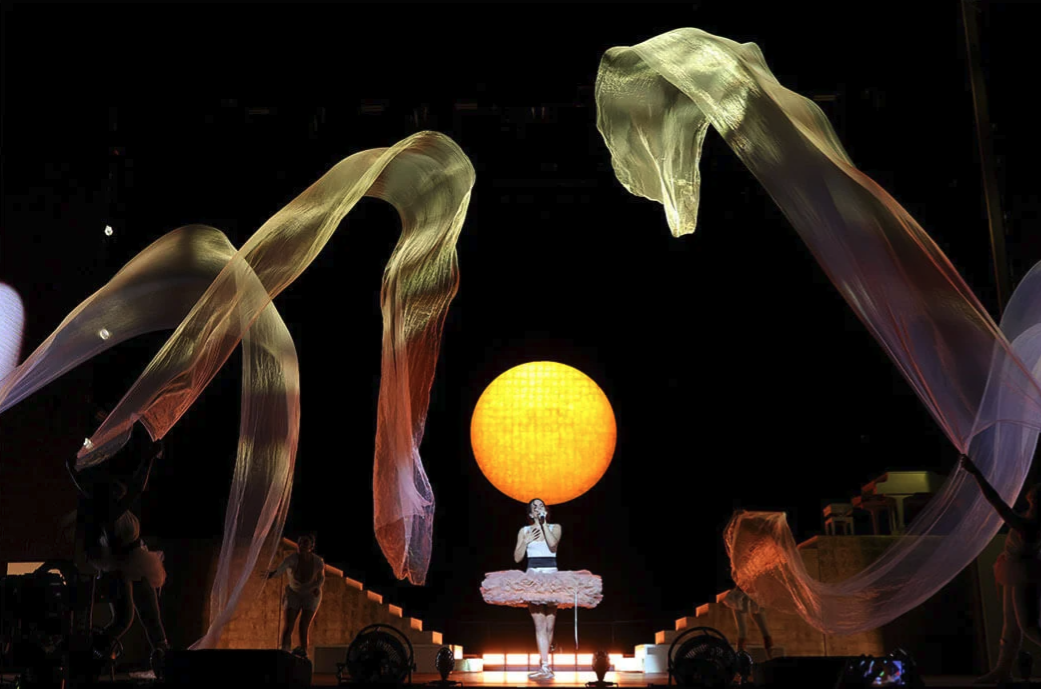
For the movement that follows, the gradual opening of the immense stage structure, has nothing natural about it. It is calculated, stretched, choreographed with such precision that it becomes, in itself, an expressive gesture. A manufactured temporality, designed to produce attention.
The structure behind which the stage space is revealed immediately evokes the reverse side of a painting: its wooden frame, its fastenings, Rosalía’s signature, and the workshop stamp marked LUX. The structure is monumental, and apparently functional. But above all, it carries a symbolic weight that is difficult to ignore.
What is contained here is precious. Fragile. Worth protecting. And therefore: worth looking at.
At the center of this deployed structure, a box appears. Small. Intimate. As if the act of exhibition doubled back on itself, as if showing required being shown.
Then: appearance.
Rosalía.
Frozen in a ballet tutu.

What happens next, almost instantaneously yet still perceptible, is a rather radical inversion of hierarchy: what the box was supposed to contain becomes secondary, almost invisible, and what was contained becomes the sole focal point. So, there we go: the canvases reveal a transport crate for a work of art, inside which the artist appears. The stage is therefore no longer the artwork. It is what allows the artwork to exist. And the artwork, here, is her, Rosalía, and, by extension, all the stagings that will weave her performance.
Yes, the artwork is Rosalía. Not simply in an aesthetic sense (which would already suffice), but in an almost liturgical one. As if what we were witnessing were not merely an appearance, but a religious manifestation, something akin to a Marian apparition. Though perhaps I am pushing the analogy a little too far.
Let us return to the performance.
In her pink tutu, Rosalía does not merely embody dance. She embodies the memory of dance.
Its history.
Its discipline.
Its codification.
Its art.
References immediately surface: Swan Lake, of course, but also something more cinematic, more pop-cultural, evoking Black Swan. And these references do not impose themselves authoritatively; they circulate, offering themselves as possible lines of interpretation.
For nothing here is neutral. Every symbol. Every framing. Every camera movement, whose live shots are projected onto massive screens on either side of the Accor Arena stage, is meticulously calibrated.
Everything contributes to the construction of a dense, almost saturated visual language, one that demands active interpretation from the viewer. Or, to put it differently: the performance is not simply watched. It is completed by the one who watches it. It is art presenting itself while simultaneously inviting reflection on how it is interpreted, understood, loved.
When I say that what we are seeing belongs to the realm of art, it is also because the stage design relies on a true mise-en-scène, dense with symbols and intentions.
From the very beginning, above Rosalía, there is a star, a sun. Silent. Unreal. Slightly off-center. Like a surviving image from another regime of images, perhaps 1920s cinema, perhaps a collective memory that no one truly possesses, yet everyone recognizes. This sun does nothing. And yet, it acts, it narrates, like all the suns we see every day. It watches over. And that alone is enough to alter the perception of everything happening below.
At this point, it would be entirely possible (and even intellectually comfortable) to shift into theoretical analysis. To invoke image theorists, or Roland Barthes and his systems of signs; to speak of the consumption of art, symbolic dispositifs, contemporary mythologies. I have seen on Instagram that some have already done so. And I agree with their analysis: yes, Rosalía’s show is a tribute to art and to the way we consume and appreciate it.
But that is not exactly what interests me here.
Because this interpretive framework, however relevant, produces a strange effect: it explains, but in doing so, it partially deactivates what gives the experience its immediate power. What I am trying to grasp is not only what this performance means. It is what it does. The way it acts upon the body. Upon attention. Upon emotion. The way it passes through the viewer, without asking permission, through the one who watches it, the one who lives it.
As Rosalía reveals herself to us, at the heart of the pit*, an orchestra begins the opening measures of Sexo Violencia y Llantas. Rosalía sings the first lines of her song. My stomach tightens; the emotion grips me as never before.
* I must, at this point, slightly shift the perspective and leave the almost sacred verticality of the stage to descend into this intermediate zone, neither fully visible nor fully hidden: the place I occupy during the show.
What strikes immediately is not only the sound, but its origin, or rather, its apparent lack of origin. The strings vibrate, yes, with that texture both organic and disciplined that is characteristic of classical ensembles, yet the hand that conducts them remains almost invisible to me. And this detail, which might seem anecdotal in another context, produces here a rather unsettling effect: the music does not seem to be played, but to emanate.
As if it were emerging directly from the stage. As if it already belonged to the space. A sonic aura takes shape. Not merely an accompaniment, because that would drastically reduce its function, but a kind of halo. Something delicate, certainly, but also solemn, almost ceremonial. Each note does not so much seek to support as to consecrate.
Without transition, the second track, Reliquia, begins, carried by the strings of the violins. And this is where something shifts again. Beautifully.
In her dancer’s attire, Rosalía of course evokes an entire classical imaginary (which we have already begun to mobilize, consciously or not), but she also summons something else, something more intimate, more discreet.
Those small mechanical ballerinas found inside music boxes. Frozen in an eternal rotation. Delicate. Precious. And, if we are honest for a moment, slightly melancholic. Objects made to preserve. To replay. To freeze a moment within a loop.
In other words: relics. And that is precisely the word she sings: Seré tu reliquia / Soy tu reliquia / Seré tu reliquia (“I am your relic,” as translated by the subtitle strip at the top of the stage, which renders the lyrics into French).
The phrase returns. Again. And again. Like a mantra, but a mantra that stabilizes nothing. On the contrary, it opens, it unsettles. It oscillates between several regimes of meaning: offering, declaration, assignment. For to say “I am your relic” is not merely to describe a state. It is to accept, or to claim, a position. To become that object charged with affect, with memory, with projection. An object we look at as much for what it is as for what it contains, or rather, for what we deposit into it. And we, myself, the audience, remain there. Captured.
What is unfolding here quickly exceeds simple aesthetic appreciation. It is not merely “beautiful,” even though it undeniably is. No, it is operative, enchanting. Hypnotic, too, but not in a passive sense. Rather like a device that continuously activates layers of interpretation. A reading that never ceases to shift. Rosalía does not simply sing, to say so would almost be insulting in its reduction. She does not even “play a role” in the classical theatrical sense, where there would be a distance between the performer and what is performed. She does something more unstable. She becomes what she utters. Or, more precisely, and this may be where the slight vertigo of the performance lies, she moves through the symbols she mobilizes to the point of rendering them both certain and uncertain. As if, by embodying them, she were displacing their meaning. As if the relic, suddenly, ceased to be an object of the past and became an active presence.
In the first twenty minutes, with Reliquia, Divinize, and Porcelana, Rosalía occupies a space that can no longer be defined according to usual categories. She is no longer simply a performer. But neither is she a total abstraction, a purely symbolic figure reducible to an idea. She exists between the two. And it is precisely this in-between that produces the grandeur of the show. A kind of intermediate figure, then (and the word “figure” is intentionally vague, almost insufficient), drawing equally from the register of ritual and that of contemporary performance.
In fact, Rosalía becomes a priestess. But a priestess without a clear institution. Without explicit dogma. Without a stabilized framework. A contemporary priestess, in the sense that she seems to transmit something whose exact nature remains indeterminate, and perhaps must remain so in order to continue acting. For what circulates here is not a message in the strict sense. It is an organized sensation. A new form of intensity and beauty.
And then there is this statement in the lyrics where she claims not to be a saint. Which, in itself, could appear as an attempt to defuse things, a way of refusing the excessive elevation that the staging itself produces. But immediately afterward, or perhaps simultaneously, which makes it even more interesting, she asserts that she is blessed.
“No, no, no soy una santa, pero estoy blessed” — lyrics from Reliquia
This is where the tension crystallizes. Because to refuse sainthood while claiming blessing is to occupy a singular position: not to be the origin of the sacred, but to be its vector. A channel. Something passes through her. And we, in the darkness, dissolved into collective anonymity, reduced to silent silhouettes, receive it. Without a clear protocol. Without instructions. Without even knowing exactly what we are receiving. A blessing, perhaps. But a blessing without explicit content, without defined promise, without guarantee of transformation. And yet, and this is where the experience becomes difficult to rationalize without diminishing it, something is perceived. And words fall short of describing just how wonderful it is.
Something circulates. Not like an idea. Not like a discourse. Rather like a slight but real modification of one’s inner state. At that moment, even if nothing has yet been clearly formulated, even if no narrative has truly taken hold, one thing becomes certain: something has begun.
It is precisely then that Divinize emerges, a title that, for once, does not resemble one of those vaguely mystical signifiers the music industry favors because they look good on a poster, but rather a kind of performative statement, in the almost linguistic sense of the term, as if naming the experience were enough to produce it, or at least to prepare the cognitive and emotional ground necessary for its manifestation.
What then unfolds belongs (and I weigh my words, even knowing they are already too heavy) to what philosophical tradition would call transcendence, a dangerously loaded term, worn thin by advertising discourse and self-help brochures, yet still, despite everything, the least inaccurate label available to describe this very precise phenomenon: the sensation that something exceeds the ordinary limits of sensory experience without ever leaving the domain of the body.
Rosalía’s voice, across its full range, from almost confidential lows to highs that seem to stretch like a membrane on the verge of tearing, functions like a system under pressure. One has the impression that it is constantly on the brink of breaking, of cracking, of revealing the muscular effort that sustains it. Each note resembles an object suspended over a void, held by a thread so thin that the mind begins to anticipate its rupture before it occurs. And it is there, paradoxically, that the power of her voice resides: apparent fragility becomes a form of strength, or, more precisely, a strategy for capturing attention.
Because human attention, that notoriously volatile psychic capital, always fixes itself where there is a risk of loss.
From row 25, seat 9, category 1, suspended from every note, I find myself holding my breath. Literally. The lungs freeze for a few seconds, as if participating in a kind of involuntary synchronization with the sonic tension.
Emotion, for its part, rises along a trajectory one could call predictable, crescendo, intensification, saturation, and yet its effectiveness remains intact. It ultimately reaches that embarrassing zone where feeling becomes visible, where the face betrays something consciousness would prefer to keep in the shadows. And I suspect (with almost statistical certainty) that this reaction is not strictly individual.
To put it more simply, dispensing with a bit of modesty… I started to cry. And around me, I was not the only one, judging by the many sniffles.
Because yes, what is happening here exceeds the sum of the subjectivities present. A kind of collective emotional field forms, whether in the room itself or in the shared mental space of those listening, comparable to those synchronization phenomena observed in certain animal species (schools of fish or flocks of birds), where each individual adjusts to the others until a common figure emerges.
Music then acts as an invisible social catalyst: it creates a temporary community, not based on ideology or explicit narrative, but on shared affective intensity.
It is at this precise moment, when emotion becomes both intimate and collective, that the religious metaphor imposes itself, not as a stylistic flourish, but as a surprisingly functional descriptive hypothesis. The figure singing appears less as an artist in the traditional sense than as a medium, a living interface between a diffuse energy and an audience that, often without realizing it, seeks to be traversed by something greater than itself.
The whispers in Rosalía’s lyrics resemble confidences murmured in the dark. The vocal rises evoke invocations. The silences take the form of sacred intervals, those moments when the absence of sound becomes almost more meaningful than sound itself.
And I sometimes have the impression (an impression I state fully aware of its slightly irrational character) that Rosalía’s voice does not merely transmit a message, but alters the state of reception of those who hear it. It produces a particular quality of attention, an inner posture close to devotion, as if listening became a moral, almost religious activity, but also a tacit commitment to the present moment.
What is perhaps most troubling is that this experience remains radically subjective while being manifestly shared. Each person projects their own memories, their own lacks, their own wounds into the lyrics, which means the emotional content varies from one individual to another, and yet, despite this invisible diversity, something converges. A kind of common language emerges, not from words, but from timbre, from breath, from that sonic vibration that acts as a sensory gathering point. I have rarely felt this during a live performance (in truth, I can think of only two or three other examples).
I could summarize all of this by simply saying that we are moved. But that would be an almost offensive simplification. What is really happening resembles an inner displacement, a subtle but irreversible movement triggered by a force whose exact nature remains mysterious, and whose very secrecy may be the main reason we continue, again and again, to listen.
This track, Divinize, I think, made Rosalía a little more divine in our eyes.
After this piece comes Porcelana, equally grand, and then the energy settles slightly as Rosalía pauses to speak with us, her audience, a moment which, in the classical economy of live performance, should function as a simple parenthesis (the artist thanks, the audience applauds, the narrative machine breathes), but which here transforms into something far more subtle, almost experimental in its effects.
She addresses the room. The room listens. And between these two seemingly trivial actions, a series of micro-cognitive adjustments occurs, the sum of which creates a sensation difficult to name without resorting to somewhat excessive metaphors.
First, there is the question of language, that back-and-forth between Spanish, English, and that slightly hesitant French, grammatically imperfect yet emotionally precise, carrying the particular texture of words learned late, through effort, and therefore spoken with an almost tactile concentration. This linguistic approximation, far from diminishing Rosalía’s symbolic presence, in fact acts as a revealer of humanity, of a sincerity without equal, and of a delightful, disarming humor.
The priestess Rosalía, the quasi-mythological figure that the performance has patiently constructed, suddenly becomes that identifiable, touching, fallible friend. Or rather: she becomes human again, for a few seconds, like a character momentarily setting aside her iconic stature to breathe, to present herself as a friend, the very friend I had encountered in my dream.
What then strikes, with almost unsettling intensity, is this perfectly irrational yet widely shared impression that she is not speaking to an anonymous mass of thousands, but to each individual separately. As if speech, instead of dissolving into the acoustic space of the arena, fragmented into microscopic particles capable of reaching each ear individually.
But the show must go on, so she clears her throat and says: “focus!”
A brief, light, almost conspiratorial laugh ripples through the crowd like a wave of muscular release. One could almost measure the collective drop in tension, in shoulders, in jaws, in breathing. Then Rosalía offers us a playful, amused wink. It is the moment when the spell of the performance loosens slightly, not enough to disappear, but enough to allow a form of familiarity to pass between her and us, like when a particularly charismatic teacher makes a joke in the middle of a difficult lecture and the entire class suddenly remembers it is made up of human beings.
In the arena, silence returns. Sharp. Compact. Almost disciplined, which, in a space filled with thousands of excited bodies, is already a kind of ritual feat. Then the first words begin to fill the space, and Mio Cristo Piange Diamanti begins. The transition is so abrupt it feels like a controlled free fall: we are immediately plunged back into a form of collective hypnosis, that temporal suspension in which seconds cease to accumulate linearly and instead become dense blocks of experience.

Rosalía now appears dressed in white, veiled, and the visual reference imposes itself with almost unconscious clarity: something that directly evokes Giovanni Battista Salvi, or more precisely, his iconography of the Madonna, that representation of maternal purity which Western art history has reproduced for centuries, to the point of turning it into a universal visual archetype. An image precise enough to activate, within the collective memory, an entire network of cultural associations: protection, gentleness, the promise of absolute love, and, by extension, the idea of possible redemption, even within a context as ostensibly profane as a pop concert.
The gestures become slow, calculated with an almost hieratic precision. The gazes, sustained, directed, create a paradoxical intimacy within a space that is nonetheless immense, as if physical distance were being compensated by an increased intensity of attention.
The voice, once again, acts as the primary vector of this transformation. It does not merely articulate words; it distributes sensations. An impression of purity, of wisdom, but also a latent tension, a promise unfolding before us, something akin to desire yet refusing resolution.
From the whole emanates an almost excessive harmony, excessive in the technical sense, that is, exceeding the spectator’s capacity to absorb such emotional intensity without feeling a slight internal resistance.
Then comes the final note. Very high. Beyond comprehension. Carried by strings and percussion, it produces a strange sensory phenomenon, difficult to describe without sounding mystical: a sensation of physical elevation. Not a metaphor, not a poetic image, but a real bodily impression, as if the ribcage were lengthening, as if the body’s center of gravity shifted slightly upward for a fraction of a second. And at the exact moment when this elevation might fall back, when the organism would demand a return to homeostatic balance, she continues.
Change of set.
Change of outfit.
Change of light.
Change of world.

This time, the imaginary being invoked is no longer that of the protective Madonna, but something darker, more archaic, an aesthetic that immediately recalls Francisco de Goya and his Witches’ Sabbath, that vision of a nocturnal gathering in which the community forms not around consolation, but around transgression.
The star, the sun, from the beginning is no longer present.
The set darkens.
The symbolic temperature drops.
And above all: the collective body enters the scene, with this track, Berghain, first in its original version, followed by its remixed form, thus opening Act II of the performance.
The dancers, directed by (La) Horde, launch into a choreography that resembles less an artistic performance than a physiological release, a discharge of accumulated energy. The movement becomes repetitive, circular, almost compulsive, propelled by a rhythm akin to hard techno and amplified by stroboscopic lights that fragment visual perception into a series of discontinuous images, as though the brain were receiving photographs rather than a continuous flow.
It is another kind of sacred, as contemplative as it is cathartic.
Here, it is no longer a matter of ascending toward some form of ideal, but of emptying oneself, of releasing the tension stored in the body, of temporarily dissolving individual identity within the repetition of collective movement. A kind of symbolic cleansing, comparable to those ancient rituals in which the community gathered to expel its fears, its desires, its frustrations.
At that precise moment, the boundary between spectacle and ritual becomes almost impossible to trace.
One no longer quite knows whether one is witnessing a contemporary concert, produced with sophisticated technology and industrial logistics, or the reactivation of a much older practice, a social mechanism invented long before electricity, long before the cultural industry, when humans were already gathering to dance, to cry out, to tremble together in the hope of appeasing something invisible. Which, in the end, may amount to exactly the same thing. And I believe that what has just been summoned in that instant is one of the oldest forms of art: dance, dance in its purest, most ancestral, and most human form.
After the first section, already saturated with sacred imagery and quasi-cultic tensions, the performance pivots with a rapidity that resembles less a narrative transition than a chemical mutation. As though one were passing, without prior warning, from a white, clinical monochrome to an explosion of red and black, two colors historically laden with contradictory symbolism (danger and desire, sin and vitality, blood and festivity), which here blend into an aesthetic of almost theatrical flamboyance, where each gesture seems slightly broader, more supple, more aware of its own power of seduction.
The solemn gravity of the previous tableau, that kind of religious dignity the audience had accepted without question, gradually gives way to a different mood, more playful, almost conspiratorial. A discreet humor then circulates through the stage space, not in the form of explicit jokes but through micro-expressions, sidelong glances, the tilts of Rosalía’s head that signal to the attentive spectator that something irreverent is unfolding beneath the surface of the official spectacle.
And then, at a precise moment (impossible to date exactly because collective attention is already in a state of semi-enchantment), there appears this explicit detail: a tight shot by the director on Rosalía’s underwear, granting us a twerk for the ages…
What follows belongs to a fascinating psychological phenomenon: the audience’s imagination begins to circulate like a hysterical clamor, oscillating between fascination and amusement, desire and complicity. One could almost observe, if one had an instrument sensitive enough, a simultaneous variation in heart rates across the room, an involuntary synchronization triggered by the collective recognition of an erotic sign, openly assumed yet handled with enough irony to avoid any vulgarity.
Then come the emblematic tracks from earlier albums, notably Saoko, a piece which, in this context, ceases to be a mere song and becomes a social device. The refrain “Saoko, Papi, Saoko” gradually transforms into a kind of ritual formula, repeated by thousands of voices with hypnotic regularity.
It is no longer a song. It is an incantation.
The giant screens framing the stage multiply angles of view with almost clinical precision. Every hip movement, every rotation of the wrist, every millimetric displacement of the body is reproduced, enlarged, dissected, lending the whole a slightly obsessive dimension, as though the choreography were the result of a long scientific experiment aimed at determining the exact position of the body capable of maximizing emotional impact.
One might, without straining the comparison, relate these gestures to certain shamanic practices, in which the repetition of movement serves to induce a modified state of consciousness. Dance then becomes a language, a transmission, a form of pre-verbal communication that bypasses the usual circuits of rationality.
When Rosalía herself seems to enter a trance, subtle, yet perceptible in the way her eyes fix slightly beyond the audience, as if she were looking at an invisible point behind the crowd, a kind of emotional contagion takes hold.
The audience follows. The rhythm asserts itself. Individual boundaries loosen. And that is no small thing.
After about an hour of performance, a duration long enough for physical fatigue to begin mingling with emotional excitement, a scenographic event occurs that allows for a pause, for the recovery of breath: the gigantic frame dominating the stage, that structure evoking the inverted canvas of an artwork, slowly closes.
As I was saying earlier, this “gesture” carries an almost symbolic dimension: it is as though one were closing a box containing this precious, fragile, or dangerous work that has, for the past hour, been casting its spell over us.
Suddenly, the giant screens offer a close-up of another protagonist of the performance, often invisible yet essential: the orchestra. The Heritage Orchestra appears in all its visual complexity, tight rows of violins, percussion aligned with near-military discipline, bows rising and falling in unison like mechanical wings. The mobile cameras cut between close-ups of the percussionists, the violinists, and even that virtuoso of hand-clapping whose name escapes me, but whose trace I would so much like to recover.
Under the direction of the formidable Cuban conductor Yudania Gómez Heredia, the music takes on an epic, almost cinematic dimension, one of those expansive sonorities that immediately conjure vast landscapes, heroic conflicts, emotions so heightened they verge on the mythological.
This orchestral interlude suspends time. But only to better prepare the next surge of intensity.
And that surge is triggered by the piece El Redentor.
The very title, laden with religious connotations, functions as a narrative signal: something significant is about to unfold. The sonic tension becomes electric, vibrating, almost surprising in its density.
Rosalía then appears on the stage staircase, holding her silver microphone mounted on a stand, an object which, in this context, ceases to be a mere technical tool and becomes a symbol of power. A sceptre, quite literally, the instrument through which authority is exercised.
And something very particular occurs in the way she occupies space: a presence that does not merely make itself visible but seems to radiate physically throughout the venue, as though emotional energy were circulating in the air as invisible heat.
In continuity with this movement, the set transforms once again, and certain spectators (selected, it seems) find themselves almost facing her, separated by that same staircase on which Rosalía stands, framed by a structure that immediately evokes a foundational work in the history of art: the Mona Lisa by Leonardo da Vinci. The reference is subtle yet unmistakable: a golden rectangle, a central figure, a carefully calibrated distance between the work and the observer.
As this image settles into the audience’s mind, Rosalía performs Can’t Take My Eyes Off You, a song immortalized by Frankie Valli, whose simple melodic structure and direct declaration of love contrast with the visual sophistication of the staging. The result is a strange, almost paradoxical sensation: a sensual elegance intertwined with an affective distance, as though intimacy were being offered only to be immediately withdrawn. And above all, that persistent impression, difficult to articulate without sounding faintly paranoid, that the artist is not merely being watched. She is also watching. She observes the observers. She transforms the audience into an object of attention, subtly reversing the traditional relationship between stage and auditorium. What emerges, at the very heart of the performance, is a fascinating perceptual loop: we look at her, she looks at us, and within this silent exchange, each becomes simultaneously subject and image.
Within this carefully selected audience, the artist suddenly spots a friend: Salomé. The gesture appears spontaneous, almost accidental, but one quickly understands that it belongs to a perfectly calibrated dramaturgical mechanism: a feigned recognition that allows for the introduction of a new narrative register without breaking the emotional continuity of the performance.
The two protagonists then detach themselves from the main set to join another, located only a few meters away yet belonging to an entirely different symbolic universe. And it is at that exact moment that the concert suddenly tightens, turning into something even more incarnated, more fragile, more vulnerable still: another instance of ancient art, a moment of theatre, pure theatre.
The set that appears is that of a confessional, an immediately recognizable structure even to a largely secularized audience, a booth divided by a latticed wooden panel, a space historically intended for the confession of faults and the search for a form of moral redemption. This miniature architecture, placed at the center of a gigantic stage apparatus, produces an almost comic contrast: a small box of intimacy installed in an ocean of gazes.
Facing Rosalía now stands the actress Salomé Topuria, and here one must pause for a moment, deliberately slow the rhythm of the narrative, to acknowledge what is truly at stake in her presence.
For what strikes one immediately about Salomé is not merely her ability to act, a competence that might be considered a minimal prerequisite for any professional actress, but a much rarer quality: a form of emotional accuracy that refuses demonstration. She possesses that discreet stage intelligence which consists in never underlining the effect, in allowing the situation to breathe, in trusting the spectator to perceive irony or tenderness without the need to announce them.
Her face, mobile, expressive without being theatrical, acts like a precision instrument. A slight narrowing of the eyes, a micro-hesitation in the voice, a deliberately prolonged breath are enough to establish a comic or melancholic atmosphere. She practices an art of detail, almost cinematic, which contrasts delightfully with the monumentality of the spectacle surrounding her.
In this seemingly trivial scene, she recounts her professional misadventures: a failed audition, an awkward boyfriend, those minute humiliations that make up the daily life of ordinary individuals. And this deliberately mundane narrative acts as an anchor of reality within a universe saturated with religious symbols and mythological and artistic references.
What is remarkable is the way she manages to transform this banal anecdote into a credible dramatic object. She does not seek to provoke loud, immediate laughter. Rather, she cultivates a precision-based humor, almost surgical, which emerges in the interstices of the dialogue, a humor that makes one smile even before the brain has identified the joke.
Above all (and this is essential), she never breaks the spell. She plays with the situation without desacralizing it. She intuitively understands that the scene functions as a ritual, and that her role is to introduce lightness without dissolving the symbolic tension.
Meanwhile, Rosalía adopts a new, unexpected posture: that of a curious, amused, almost complicit priestess. She listens with a feigned yet warm attentiveness, oscillating between spiritual authority and adolescent camaraderie.
A mischievous priestess, in a way.
A sacred figure who consents to laughter.
The scene may indeed recall, for those who possess the corresponding cultural reference, a specific moment from the television series Fleabag (season 2, episode 5), where religious confession becomes a space of ambiguous intimacy, blending desire, humor, and a search for meaning. But here, the resemblance operates more as resonance than imitation. There is, one might say, more playfulness, more human warmth, and less existential despair*.
* I also thought of the painting La confessione by Giuseppe Molteni, though it is difficult to interpret everything given the diversity of artistic influences at play in the performance.
At the center of this delicate mechanism, Salomé reveals herself, discreetly yet undeniably, as an actress of remarkable finesse. She masters light presence: that ability to occupy space without saturating it, to attract attention without demanding it. She allows the energy of the stage to circulate, she truly listens to her partner, she reacts with a controlled spontaneity that creates the illusion of perpetual improvisation.
The video direction, for its part, amplifies this quality. Close-ups capture the nuances of her expression, a half-restrained smile, a gaze wavering between irony and sincerity, and transform these gestures into visual events. The camera becomes almost an accomplice, revealing the emotional texture of the moment with surgical precision.
What then emerges, at the very heart of this monumental spectacle, is a fascinating tension between two seemingly incompatible registers: comedy and ritual.
Salomé, with quiet elegance, manages to hold these two poles together. She elicits laughter without profaning, humanizes without trivializing, introduces everyday fragility into a universe dominated by symbolic grandeur. In other words, and this is no trivial compliment, she acts as a point of equilibrium. A presence that reminds us that behind myths, icons, and spectacular devices, there are still individuals who stumble, who fail, who recount their small sentimental catastrophes with a mixture of restraint and self-irony.
And it is precisely this humanity, modest, imperfect, deliciously recognizable, that makes the scene unforgettable. And which, in echo, crystallizes the homage Rosalía seeks to pay to art, while embodying it within a quasi-religious register that serves the narrative of her performance and reveals her all the more as a sister, a priestess of an entire world, carried by a remarkable benevolence and humanity.
After this scene, a return to reality with La Perla, or rather, to what La Perla does to reality. A majestic performance, yes, but “majestic” in that almost destabilizing sense where the word itself feels too small, like a poorly fitted garment for something fundamentally overflowing.
During this piece, the choreography conceived by Dimitris Papaioannou organizes itself around Rosalía not as a mere accompaniment, but as a kind of gravitational system: the dancers’ arms orbit, coil, cling to her, almost covering her, and for a fraction of a second (or several, the perception of time here becomes suspect, malleable), she ceases to be a singer and becomes a surface for mythological projection. A Venus de Milo, yes, but mobile, breathing, and (a crucial detail) aware of being watched, which introduces an additional layer of vertigo. Every gesture seems to signify something, yet that something slips away, eludes, refuses to be reduced to a fixed meaning. It is poetry that knows itself to be poetry.

With Sauvignon Blanc, a moment which, on paper, might appear minor, almost interstitial, the piece instead becomes a kind of discreet emotional core. Rosalía sits on the piano, accompanied by a childhood friend, a biographical detail which, whether factual or performative, immediately produces the illusion of shared intimacy. Her friend plays, and one notices (because this sort of detail suddenly becomes essential) the way his fingers barely hesitate over certain transitions, as though he were playing as much for her as for us. Together, they construct a fragile, almost domestic space in the midst of the vastness of the Accor Arena.
The crowd, of course, does what any contemporary crowd now does: it lights up its phones. But instead of merely illuminating, it transforms. The Accor Arena becomes an improvised constellation, thousands of points of light, each carried by an individual intention, dissolving into a single collective image. Here again, mythology seeps in: our earlier Venus de Milo metamorphoses into Syrinx, a figure of the voice transformed into instrument, of breath turned into matter. The high notes (and especially the final ascents, those that brush against the physical limits of the voice) produce that effect of suspended time: one feels, very concretely, the audience holding its breath (again), as though breathing itself had become an interference. It is a collective pause, a brief silence saturated with tension, followed by a gentle descent, a return to flow, to gravity, to the fact of still being there, within a body.
Perhaps that is the most unsettling point: at every moment, Rosalía does not “perform” a song. She operates a series of symbolic translations. She becomes, successively (and sometimes simultaneously), myth, icon, artwork, offering. She halts time, just as one halts time by taking photographs, or by attempting to preserve it through videos of singular moments. And that is precisely what we do, we spectators, but also involuntary participants: in these moments of spectacular grace, we become archivists, in an almost pathological sense, we record, we document, we attempt to capture something that, by definition, exceeds capture.
10:15 p.m, the track La Yugular begins, and with it a new visual logic, almost authoritarian in its coherence. Low-angle shot. Rosalía behind a pane of glass, a device simple in appearance, yet producing a surprisingly complex effect: she is at once exposed and separated, offered to the gaze and protected by an invisible barrier. The glass catches the light, diffracts it, sends it back at improbable angles. One begins to notice very specific things: the way a beam fractures along an edge, how a silhouette doubles, how the camera seems to search for (and sometimes lose) its subject. This is not merely aesthetic. It is almost tactile. One has the impression that light has texture, that the music settles physically into space.

Then, a change of set, another interlude, this time titled Art Cam. A member of the audience appears on one of the screens, slightly surprised, faintly flattered, and immediately compared to a work of art: the Girl with a Pearl Earring by Johannes Vermeer, among others. The device is simple, almost gimmicky, but it operates with formidable precision. The audience laughs, not a mocking laugh, but one of recognition, as though everyone simultaneously understood both the joke and its mechanism. There is, in this, a form of complicity, a shared intelligence between stage and auditorium. Rosalía reminds us, in that instant, that we are all, in the end, works of art in our own way.
When she reappears, crossing the central space, elevated, something has changed. The quasi-deific figure of the artist (and the word is not too strong here) reconfigures itself. She becomes accessible, or rather, she gives the highly controlled illusion of accessibility. In her Spanish diva attire, she begins La Rumba del Perdón, at the heart of the audience. She is close, almost within reach, and yet maintains that intangible distance which is precisely what makes her an icon.
Then comes this gesture, tiny on the scale of the spectacle, yet enormous in its implications: Rosalía sings a deeply sensual “happy birthday” to a fan. One might analyze it as a simple moment of interaction, a concert staple. But that would be to miss its true charge. For a few seconds, all attention, the entire symbolic machinery, the full aura, is focused on a single individual. A kind of extreme condensation of the experience: to be seen, recognized, woven into the narrative. For that spectator (and for that night alone), the offering is total, the memory indelible. For us, witnesses to the scene, there remains the sensation of having witnessed something profoundly authentic.
We move gently toward the final part of the concert. The rhythm shifts, and once again, this “shift” is not a simple variation but a perceptual distortion, a slippage in auditory gravity. The music becomes syncopated, and it is not merely a reference to drum and bass emerging from the speakers: it is the physical sensation of something pulsing irregularly within the body, making both foot and heart hesitate, a beat that refuses linearity. Above Rosalía, as she finishes singing CUUUUuuuuuute, a giant censer floats like a suspended relic above the pit of the Accor Arena, releasing swirls of smoke that mingle with the stroboscopic lights.
There, at the top of the stage, in luminous letters, a sentence appears: “Car ici, le meilleur artiste, c’est Dieu” (For here, the greatest artist is God), a phrase which, out of context, might pass for a stage gimmick or a marketing slogan, but within this performance becomes simultaneously an artistic, theological, and aesthetic statement. God, tonight, is a goddess, a figure embodied, breathing, and her name is Rosalía. In that moment, there is a form of visual theology, where smoke, light, and the artist’s body construct a temporary yet credible divinity.

When Rosalía leaves the stage, the sound system releases Sweet Dreams, an instrumental echo derived from the previous track, with that same censer still there, floating like a pendulum, like a metronome. The trance does not break; it continues, stretches like an elastic band, suspending the audience in an intermediate state. Between awareness and total immersion, the spectator drifts, oscillating between rationality and an almost physical surrender. One senses the subtle shift: the body responds before the mind, and the mind begins to catch up with what the body is already experiencing.
Then comes the fourth and final movement of the show. The last one, and perhaps the most overwhelming. It brings us back to something closer to the traditional concert form, yet transfigured, as if every gesture, every beam of light, every collective breath had been calibrated with an almost ceremonial precision to distill within it the most beautiful madness and the most radiant poetry. Already, the title Bizcochito: the crowd takes up the chorus, but not merely in a passive way. A single collective body forms once again, oscillating between pure pleasure, exuberance, and something one might call transcendence… Yes, that word again. Rosalía, draped in feathers and wings, crosses the stage like a living myth. With Despechá, every movement of the star becomes a sign, every step a bodily metaphor, and at the same time she traverses her own mythological imagination, and ours, so thoroughly that the distinction between artist and spectator becomes almost blurred.
Then comes Focu’ ranni. Frenzied dance, celestial choreography, where Rosalía becomes an archangel, surrounded by human cherubim, but not only that. Once again there is a collective memory in the room, a shared mythological recollection, a continuum between ether and breath. The emotion is dense and ambivalent: melancholy and strength, resilience and redemption. The final fall from the staircase evokes the scene from Black Swan, as well as the figure of Icarus, but here the hubris of the myth dissolves: it is no longer a question of reckless excess or danger, but of fulfillment, transformation, and artistic liberation. The verticality of the gesture, the light, the breath of the audience ; everything converges toward a performative ecstasy in which myth becomes bodily experience.
And then, the Saint of feathers slowly ascends the steps, one by one, as though each movement carried the weight of the sky. Upon reaching the summit, she unfurls her wings in a shiver of light, a fragile gesture, almost sanctified, and then, suddenly, the world gives way. Her body tilts backward, silent, and she falls, not like a stone, but like a prayer released into the air. And already, she is no longer there: dissolved into the atmosphere, into the void, even before being consumed.
The gigantic canvas closes once again.
Applause, bursts of sound, cries of joy and love ripple through the crowd.
Suddenly…
Rosalía returns as if resurrected, divine, with Magnolias, for one final blessing, one last miracle. Religious choirs, celestial light, Rosalía slowly disappears behind those painted backdrops, into a vivid light, almost blinding. But she does not truly vanish. No: she reasserts herself, reinvents herself, resonates like a resurrection, a manifesto that living art transcends temporality and renders itself immortal. And if a single work of art was contemplated and invoked tonight, if everything we lived could be condensed into one single manifestation of Beauty, it was there, in space, embodied, singular, extraordinary, alive.
It was LUX,
It was the Light,
It was Rosalía.
21 MARCH, PARIS, PARC DES BUTTES-CHAUMONT, 4:25 PM
The day after the concert, I am in the park, thinking back to what I witnessed the night before. This morning, I woke up early to write the first draft of this chronicle, so as not to forget certain details and sensations. Sitting on a bench, gazing at the trees in an almost unfamiliar way, I find myself thinking that the experience did not truly end when Rosalía left the stage. It continues in the bodies and minds of the spectators, just as it continues in my own, in my memory, like a lingering vibration, almost insistent, to the point of blending with life itself.
I then recall my dream. Not simply its content, but the texture of the feeling that ran through it, the one I described at the beginning. A precise sensation, almost locatable in the body, somewhere between the chest and the throat, like a gentle yet persistent pressure. And what is troubling is that this very same feeling returns now, here, after this concert, with nearly identical intensity, as if two experiences that appear unrelated actually share a common internal structure.
Which compels me, if one pushes the thought a little further, to consider that this concert may not have been merely an aesthetic or musical event, but a relational device. A kind of machine (conscious or not) designed to produce connection. Between her and me, yes, but also between her and that anonymous audience which, for two hours, became something like a coherent entity. And this idea of connection, which may seem abstract, suddenly becomes very concrete when compared to that extremely ordinary yet mysterious experience: contemplating a work of art and feeling, almost immediately, that an exchange is taking place. That something is circulating. That one is being touched, quite simply.
And perhaps… perhaps that was precisely what I came looking for without knowing it. Not merely to see, to hear, to document (all those activities that create the illusion of controlling the experience), but to experience that very particular feeling of active contemplation. That moment when Beauty creates a form of unexpected friendliness. A closeness. As if the work, or here, Rosalía’s performance, were extending a hand, and the spectator, without truly deciding, were taking hold of it.

This leads to a fragile hypothesis, yet one that becomes difficult to ignore once it has been spoken: what if what I felt that night belonged simultaneously to dream and to life, without one cancelling the other out? As if the dream were not an escape from reality, but a particular mode of reality itself. A way of intensifying certain aspects of it, of revealing layers that are usually imperceptible. And within that framework, art, whether it takes the form of a performance, a painting, a choreography, a film, would not be a simple object to consume or analyze, but an operator. Something that produces dream within life, and life within dream.
Above all (perhaps the most difficult point to admit, because it flirts with a kind of naïveté we have learned to avoid), this operator creates connection. Not only between the work and the one who contemplates it, but between individuals themselves. A kind of invisible network, temporary, yet real in its effects. And within that network, in that intermediate space where boundaries become porous, there is something that resembles love.
A love that is neither spectacular nor narrative nor easily identifiable, but that manifests as recognition. As the fleeting, and therefore precious, feeling of not being entirely alone in the face of what one feels. And perhaps that feeling, the one we sometimes believe we have forgotten, or relegated to simpler, more reassuring zones of existence, returns precisely in those moments.
Not as a revelation, but as a discreet certainty, almost embarrassingly simple: that something connects us, despite everything.
And that connection, that night, was Rosalía.
❤︎
Cover picture by © Kevin Mazur / Getty Images for Live Nation
Une réponse
[…] >>> ENGLISH VERSION OF THE ARTICLE HERE […]